What is ERP? One connected view of your business
When sales, stock and accounts share the same information, your team can spend less time reconciling spreadsheets and more time moving work forward.
NextERP · · 2 min read
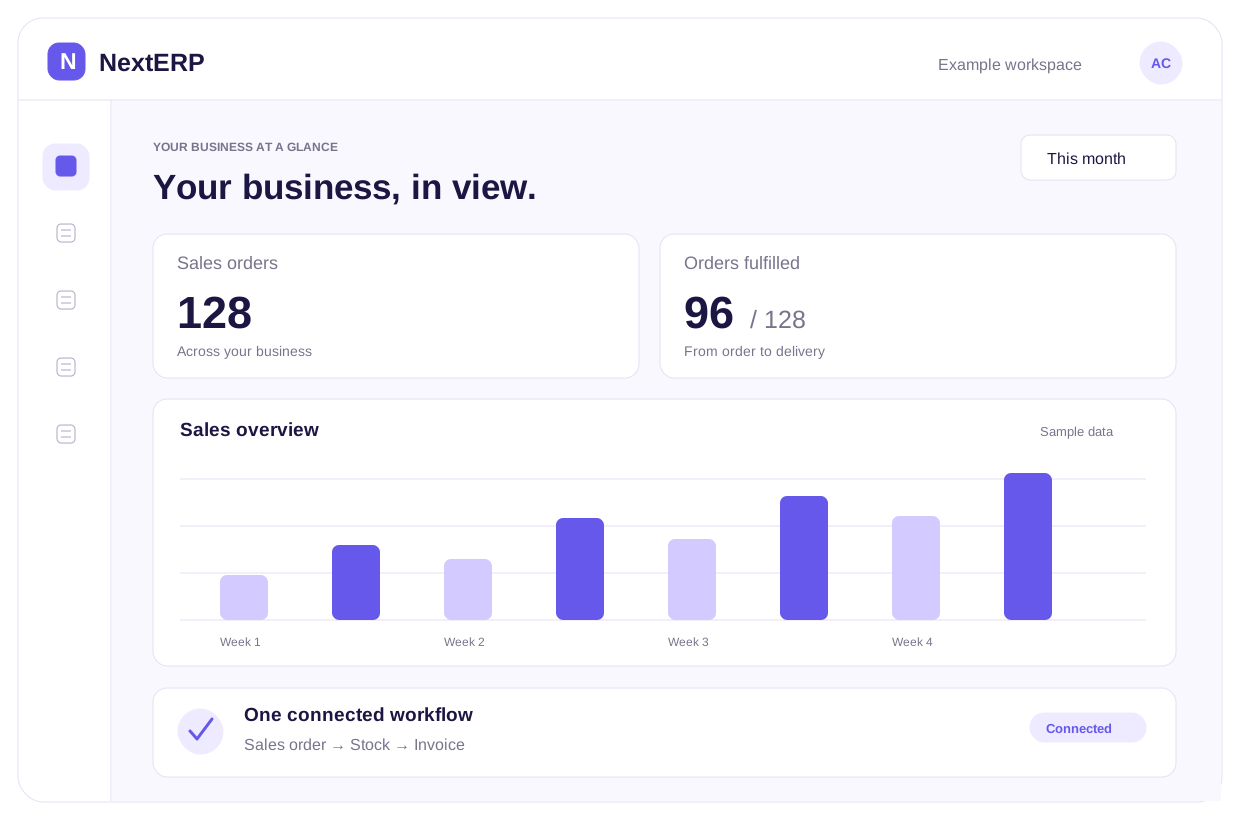
The spreadsheet problem
A sale arrives by email. Someone checks stock in a spreadsheet. Another person creates an invoice in a separate system. By the afternoon, three people have entered parts of the same order — and each screen tells a slightly different story.
Enterprise resource planning, or ERP, connects these everyday activities. Customer information, sales orders, purchasing, stock movements and accounting can share a common system. An ERP does not remove the need for good processes; it gives those processes a consistent place to happen.
Follow the work from order to payment
Consider a wholesaler accepting a customer order. The sales team needs availability, the warehouse needs picking information, and accounts needs the invoice and payment status. With a connected workflow, each team can work from linked records instead of copying the same details between tools.
- Sales: keep customer and order information together.
- Stock: record receipts, transfers and deliveries as they happen.
- Purchasing: see what needs replenishing and follow supplier orders.
- Accounts: connect the commercial transaction to its financial records.
The practical benefit is a clearer answer to simple questions: What have we promised? What can we deliver? What still needs attention?
Success story: Sree Mahalakshmi Agencies
Frappe's published customer story describes Sree Mahalakshmi Agencies, a building-materials distributor in Chennai, implementing ERPNext with Tridots Tech. The implementation brought buying, selling, stock, accounts and point-of-sale into a shared system, with POS Awesome added for the retail experience. The story reports improved coordination, stock transfers and reporting.
This is an example of an ERPNext implementation by another provider, rather than a NextERP client engagement. Its lesson is useful: connected operations become valuable when the software follows the real movement of orders, goods and information.
Read Frappe's Sree Mahalakshmi Agencies story.
Where ERPNext fits
ERPNext provides an open-source foundation for connected business operations. Frappe provides the framework underneath it, making it possible to add fields, forms and workflows as a business's requirements become clearer. Implementation still involves decisions about data, responsibilities, training and the right level of customisation.
Start with one useful workflow
Choose a process where information is being entered more than once. Map the steps, agree on who owns each record, and identify one result you can measure — for example, how long it takes to answer an order-status question. A focused first stage is easier to understand and adopt than an attempt to change every process at once.
NextERP can help you work through that first stage and connect it to a practical implementation plan. Talk to NextERP, or call 1300 19 77 99.